
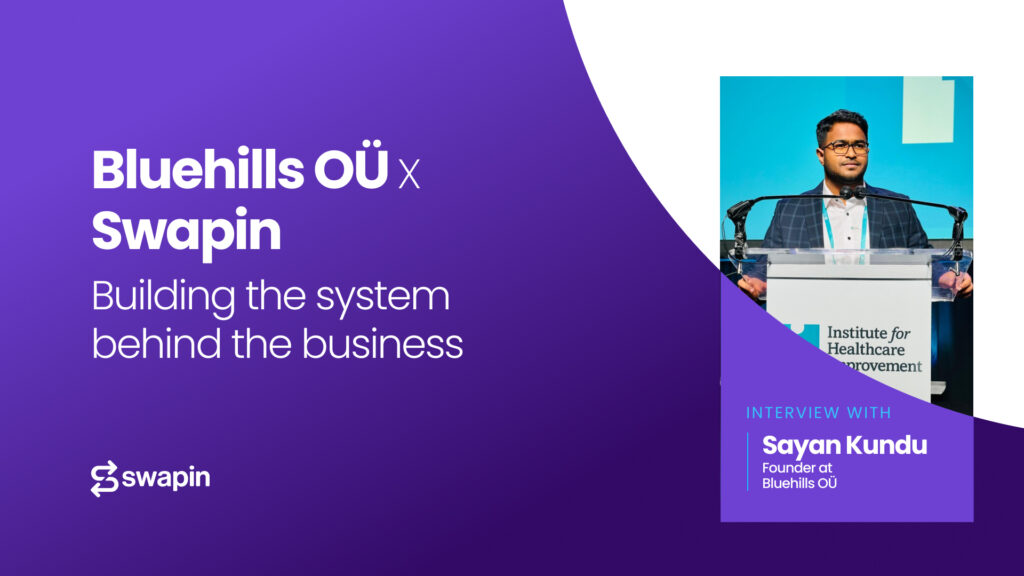
Bluehills x Swapin: Building the System Behind the Business
Section 1: Story behind Bluehills
Q: Why did you start Bluehills? What was the idea in your head at the beginning, before it had a name?
Sayan : Bluehills started from my interest in how businesses work behind the scenes. I believe a strong business is not only about investment or revenue, but about having a system where people can easily find what they need, understand what is happening, and avoid wasting time searching through files or tools.
The same applies to busy individuals who need help managing calls, emails, appointments, and daily tasks. That’s why I started Bluehills, to solve these everyday operational problems. The name Bluehills also reflects the idea of mountains: calm, stable, and reliable, which is exactly how I wanted the company to feel.
Q: You’d spent six years inside operations roles before this. Why leave that and build your own thing, instead of doing the same work with a bigger title somewhere?
Sayan : I left my previous job by choice because I wanted to build something of my own and take on a bigger challenge. I didn’t just want a bigger title; I wanted the freedom to make decisions and shape the direction myself.
There is a phrase I heard growing up that roughly means, “In a job, you work within someone else’s boundaries; In business, the river is yours, you decide how far you want to take it.” That mindset stayed with me.
Q: Why”AI-enabled operations” as the description? Where did that framing come from, and what were you trying to avoid being mistaken for?
Sayan : We use the term AI-enabled operations because AI is a tool within our service, not the whole service. We first understand the business process, identify where time is being lost or where systems are disconnected, and then use AI, automation, integrations, and human support where they actually make sense. We don’t want Bluehills to be seen as just another company trying to replace people with AI.
Section 2: AI vs human-based approach
Q: Most automation companies sell the opposite of what you sell. They lead by replacing manual work; you lead with people, supported by AI. Why that way round?
Sayan : AI is extremely powerful, but I don’t think everything should be handed over to it. AI is very good at speed, organization, processing information and repetitive work. Humans are better at context, perception, judgment and understanding unusual situations. So rather than choosing between humans and AI, we try to combine the two. If you combine the speed of AI with human judgment and supervision, you usually get a much stronger result.
Q: Where does AI genuinely fall short in operations right now? Is there something you’ve tried to automate and pull back from?
Sayan : The biggest limitation is context. AI can follow a process very well when the situation is predictable, but businesses are full of uncertainty. A customer might have an unusual request, a contract might need interpretation, or a situation might require empathy rather than an automated response. That’s where we are careful.
We’re comfortable automating repetitive and structured tasks, but when something involves judgment, sensitive communication or an important decision, we prefer keeping a human involved. For us, good automation means knowing what not to automate as well.
Q: What makes it actually worth having a chatbot solution in a business?
Sayan : Availability is probably the biggest advantage. A business cannot have someone answering every customer question 24/7, especially when many of those questions are repetitive. A good chatbot can answer common questions about products, services, appointments or processes immediately.
The customer gets an answer without waiting, while the company reduces the amount of repetitive work handled by its team. The important part is knowing when the chatbot should answer and when it should hand the conversation over to a person.
Section 3: The specifics behind the work
Q: Onboarding runs 7 to 14 days. What are you learning about a client’s business in that window, before you change anything?
Sayan : Before onboarding, we first understand the client’s business or, for individual clients, their personal workflow and requirements. We review the systems or tools they already use, prepare questions based on their needs, and identify where the main operational problems are.
This also helps us decide whether we are the right fit, while keeping GDPR and relevant EU requirements in mind.
Q: Most of your work runs on a 12-month subscription. Tell us more about the process.
Sayan: Operations are not something you usually fix once and forget. Businesses grow, teams change, new tools are introduced, and new problems appear, so the longer-term model allows us to understand the business properly and continuously improve workflows, solve issues, and support the client as their needs evolve.
Q: Your team is spread across several countries and your clients are in 12+. What’s the hardest part of running that setup day to day?
Sayan : The hardest part is communication and coordination across different countries, time zones, and working styles. We solve this through clear documentation, defined responsibilities, and structured communication so everyone knows what has been done and what needs to happen next. In a way, running a distributed team has also made us better at the operations work we provide to clients.
Section 4: Getting paid across borders
Q: With clients across Europe, Asia, and the Middle East, what did getting paid look like before crypto was an option?
Sayan : International payments used to create a lot of friction for us. We mainly used bank transfers and SWIFT, and I remember a €1,000 invoice where we received around €956 while the client had paid about €1,035, so around €79 was lost in fees between both sides. Payments could also take several days, which delayed onboarding and project starts.
With Swapin, clients who prefer crypto can pay that way while we receive euros directly into our business bank account, making the whole process much faster and simpler.
Q: What made you comfortable accepting stablecoins, and was there anything you had to think through first?
Sayan : The biggest advantage is speed, but we also wanted to avoid the complexity of managing wallets, exchanges, and crypto conversions ourselves. What made us comfortable was being able to let the client pay with crypto while we still receive euros directly into our business bank account.
That makes it feel more like an efficient international payment method than something we have to manage separately.
Q: Bluehills exists to take operational drag out of a business. Did adding crypto payments add drag on your side or remove it? Specifically on the accounting and reconciliation part.
Sayan : For us, it removed drag. If accepting crypto meant managing wallets, manually converting currencies and then explaining every transaction to accounting, it would probably create more work than it solved.
What works for us is that the client can pay using crypto while Bluehills receives euros into the business bank account. That keeps our normal accounting workflow much closer to a traditional business payment while giving the customer another payment option.
From an operations perspective, faster settlement also means we can match the payment to the invoice and start the project sooner instead of waiting several days for an international transfer.
Section 5: Bluehills future plans
Q: Two years in. What does Bluehills look like at five, a bigger team or the same team with more leverage?
Sayan : Definitely a bigger team, but not simply for the sake of having more employees. We are moving from the growth stage into the expansion stage, and as we receive more work requests and longer-term contracts, we want to bring in more talented people while also using AI and automation internally so the team can work efficiently and create more value.
Q: What’s the operational problem you would like solved within the next 5 years?
Sayan : I would like to see businesses reach a point where information is no longer scattered across emails, CRMs, spreadsheets, accounting tools, and other systems. Ideally, a business owner should be able to ask one simple question like, “What needs my attention today?” and immediately get a reliable answer based on everything happening across the company.
That is very close to the original idea behind Bluehills – less searching, less repetitive work, and more clarity.